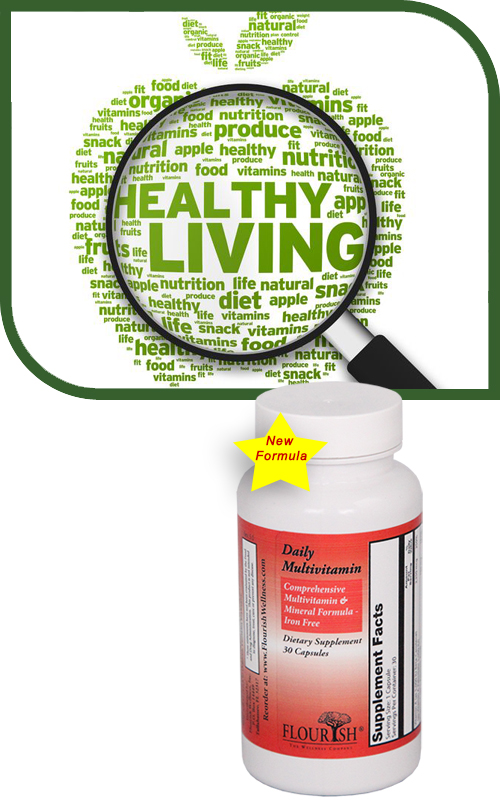
Daily Multivitamin
All adults should take a daily multivitamin, according
to research published in the Journal of the American Medical Association.
The authors, two Harvard Medical School researchers who reviewed 150
scientific studies, concluded that people who take vitamins may protect
themselves from certain chronic diseases. 1
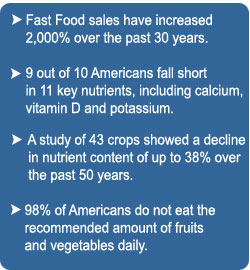
Despite extensive efforts of the government over the last 20 years
to educate Americans about proper diet, today about 75% of Americans
report not eating the minimum daily servings of fruit and vegetables.2
In fact, only 1% of Americans follow all the USDA guidelines for
healthy eating.3
Why do seniors have even greater challenges nutritionally? As we
age, our caloric intake decreases, thus our nutrient intake decreases.
In addition, aging decreases our ability to absorb certain essential
nutrients. These factors place the aging population at risk for
deficiencies for such essentials as vitamins B6, B12, D, E, Folic
Acid and Calcium.4
The simple answer is to take a daily multivitamin to supplement
food intake. Not to replace food, but to supplement our diets. A
daily multivitamin can help insure that adults, and seniors in particular,
get the nutrients they need to promote long-term health, and thus
increase quality of life. 5,6,7,8,9
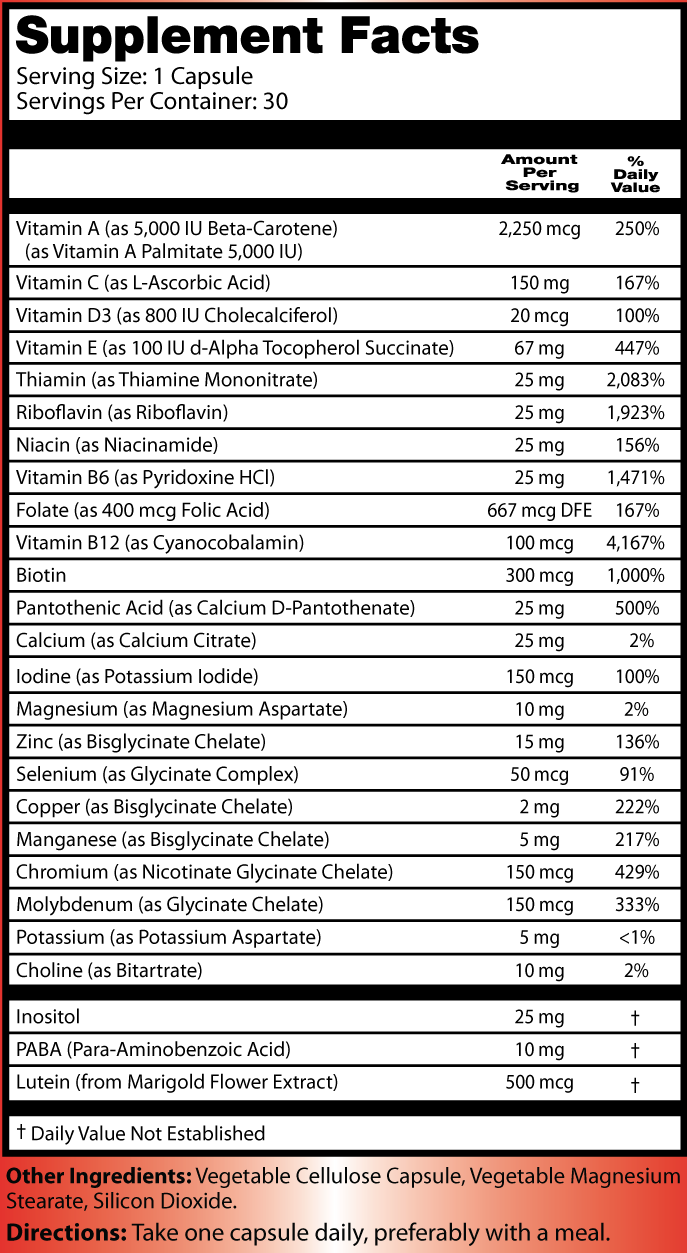
Daily Multivitamin is a top of the line Multivitamin
and Mineral that contains “30” key vitamins, minerals,
and trace elements along with Co-Enzyme Q10 and Grape Seed Extract.
Daily Multivitamin is an iron-free product that is naturally formulated
from premium quality ingredients to give you the strength and potency
you deserve. Ingredient
Profile
1. Fletcher, RH, Fairfield, KM. Vitamins for chronic
disease prevention in adults, clinical applications.
JAMA. 2002 June 19; 287 (23):3127-29.
2. Serdula, MK, Gillespie, C. Kettle-Khan L, Farrs R, Seymour J,
Denny C. Trends in Fruit and Vegetable Consumption Among Adults
in the United States: Behavioral Risk Factor Surveillance System,
1994-2000. American Journal of Pub Health. 2004 Jun 94:6, 1014-1018.
3. USDA Center for Nutrition Policy and Promotion. Report Card of
the Quality of Americans’ Diets. December 2002.
4. See Fletcher, et. al.
5. See Fletcher, et.al.
6. Booth SL, Broe KE, Gagnon DR, Tucker KL, Hannan MT, McLean RR,
Dawson-Hughes B, Wilson PW, Cupples LA, Kiel DP. Vitamin K intake
and bone mineral density in women and men. Am J Clin Nutr. 2003
Feb 77(2): 512-6.
7. Age-Related Eye Disease Study Research Group. A randomized, placebo-controlled,
clinical trial of high does supplementation with vitamins C and
E and beta carotene for age-related cataract and vision loss: AREDs
report no.9. Arch Ophthalmology. 2001 Oct; 119(10):1439-52.
8. Korczyn AD. Homocysteine, stroke, and dementia. Stroke. 2002
Oct; 33(10):2343-4.
9. Engelhart MJ, Geerlings MI, Ruitenberg A, van Swieten JC, Hofman
A, Witteman JC, Breteler MM. Dietary intake of antioxidants and
risk of Alzheimer disease. JAMA. 2002 Jun 26; 287(24):3223-9.
Back to Top
|
|
Daily
Multivitamin
Item: 211

Daily
Multivitamin
90 Tablets
$16.95
Top
of the Line Multi-Vitamin
& Mineral Formulation

..
|
|